Orbion — Smart City Platform (Exploratory)
Orbion is an exploratory smart city platform examining unified UX, domain-driven thinking, and distributed software concepts.
Visit websiteThe problem
Everyday city interactions are fragmented across multiple applications — transport, events, alerts, payments, and civic services operate in isolation. This fragmentation increases cognitive load and reduces continuity in routine tasks.
The idea
Orbion explores the concept of treating a city as a unified interface — a place where discovery, decision-making, and action can occur without repeated context switching.
The project does not aim to replace existing platforms, but to examine how they might be experienced coherently.
Why explore this
For citizens, unification may reduce friction and mental overhead. For operators, it may improve coordination visibility. For engineers, it presents a distributed systems problem expressed through interaction design.
Experience focus
The interface exploration emphasizes calm navigation, predictable hierarchy, and progressive disclosure to reduce decision effort in real-world scenarios.
Dashboard concept
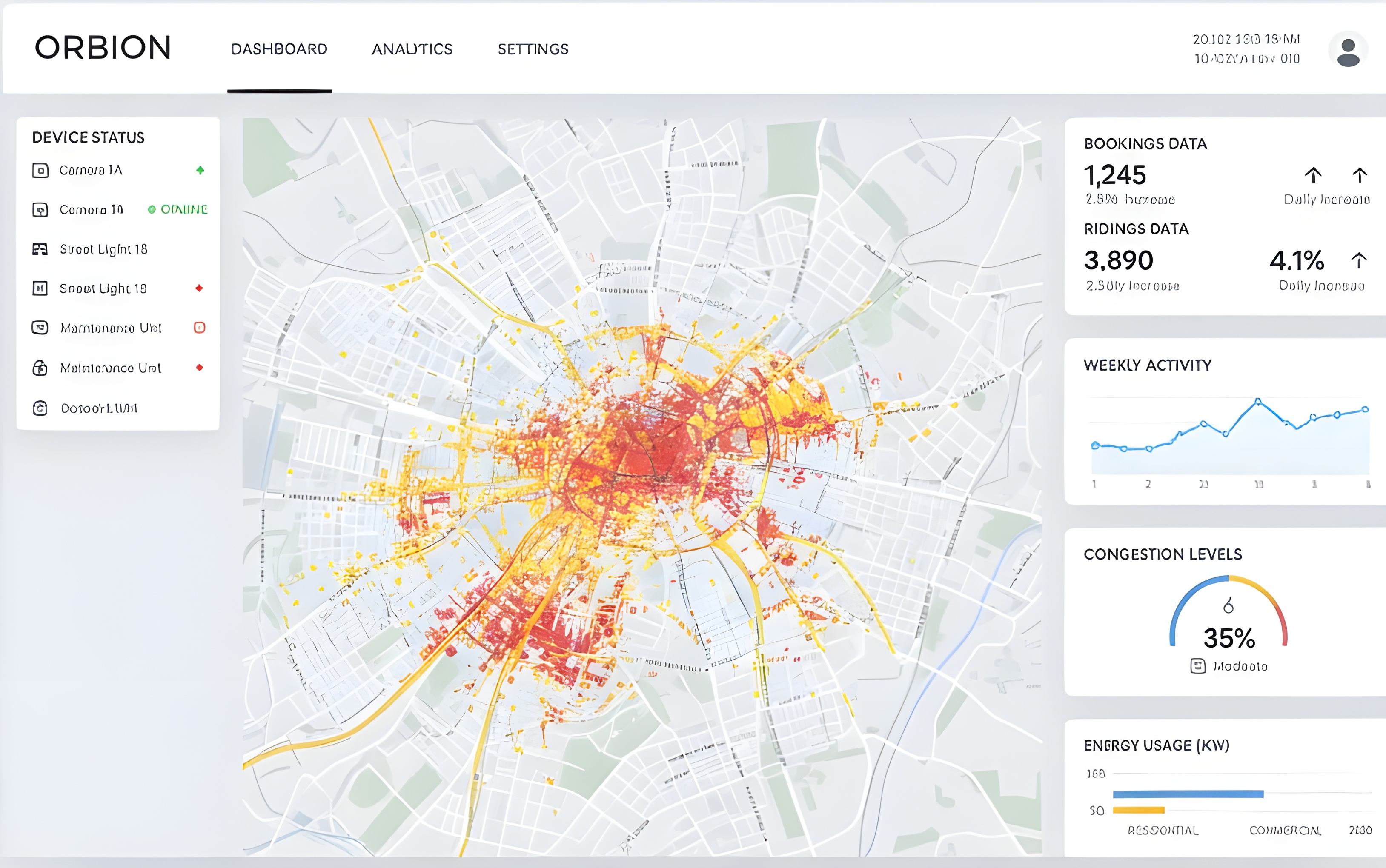
The dashboard acts as a conceptual city console — surfacing transit, alerts, events, and actions relative to user context such as location and time.
Prototype scope
This interface is an interaction prototype intended to explore layout rhythm, component consistency, and information hierarchy. Production integration and data accuracy are intentionally out of scope.
UI prototype
The preview demonstrates early structural patterns and interaction ideas. Visual refinement and live integrations are future exploration areas.
Security perspective
Security considerations are explored conceptually, focusing on trust boundaries, domain ownership, and failure isolation rather than implemented controls.
Threat-aware thinking
The conceptual model assumes partial failure and untrusted inputs by default:
- Clients are treated as untrusted.
- Domains validate and own their data.
- Failures should degrade locally rather than cascade.
Potential controls
Architectural exploration includes:
- centralized identity with short-lived credentials
- domain-scoped authorization
- explicit API contracts and validation
- encrypted communication pathways
- gateway-level rate limiting
Architecture perspective
Orbion frames a city as a distributed system composed of domain-aligned services communicating through explicit interfaces. This reflects architectural exploration rather than deployed infrastructure.
Core themes
- domain modularity across transport, events, identity, and payments
- graceful degradation instead of hard failure
- event-driven state propagation concepts
- observability as an architectural concern
Technology direction
Technology choices represent exploratory direction:
- React + TypeScript for interface prototyping
- Node.js APIs for integration experiments
- Go for potential high-concurrency domains
- Rust evaluation for critical components
- event streaming concepts (Kafka)
- relational, cache, and search storage layers
Reflection
Orbion represents an exploration in aligning ambitious system thinking with a restrained user experience surface. The emphasis remains on clarity of ideas rather than feature breadth.
Exploration roadmap
Near term
- interaction refinement and accessibility baseline
- layout consistency and semantic improvements
- limited dataset integration for concept validation
- clearer domain contracts
- platformization exploration via APIs
- observability and operational thinking experiments
Closing thought
Orbion explores a single question:What might city software feel like if designed as a coherent system?
This project documents ongoing exploration around that question.